
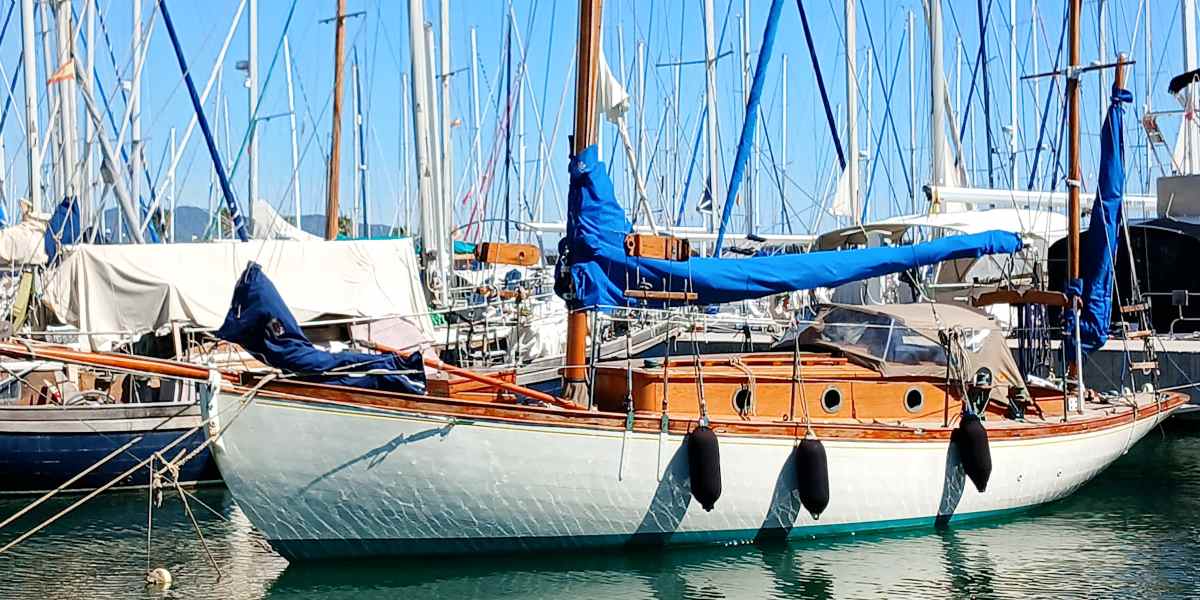
Lindy II, vintage yawl
Ref. CP136EUR 35,000 ,-
Designed by a great expert of the moment and built by one of the best Yards ever, she is a great little cruiser with blue water abilities. Amazingly balanced while sailing and in very good original conditions.
Yard:A.H. Moody & Sons
Design:Thomas Harrison Butler
Model:Bermudan yawl
Building Year:1936
Ensign:Polish
Hull Structure:Pitch-pine on oak frames. Teak made keel, stem and stern-post
Deck Structure:Teak on teak beams
L.O.A.:
Convert to
feets
9.10 m.
L.W.L.:
6.89 m.
21.00 feets
Beam:2.65 m.
8.08 feets
Draft:1.34 m.
4.08 feets
Displacement:5.26
5.26 Tm. Tm.
Type:Bermudan yawl
Winches:4xWelmex SW10 in cockpit + 2xLw7 at mast
Genova Furling:Wykeham-Martin
Main Furling:
Spinnaker Pole:Alloy
Windlass:Simpson Lawrence, hand-held
Anchors:CQR + Fisherman
Tender:
Outboard:
Safety equipment:
E.P.I.R.B.:
Engine:Beta Marine 25
Power:25 hp
Year:2012
Serviced:Every Year
Hours:
Hours:
Transmission:Tecnodrive TMC 40, shaft
Propeller:Fixed, three blades
Bowthruster:
Fuel Tank:25 l.
Main-sail:2 x Arun Sails, Terylene
Jib:2 x Arun Sails, Terylene
Genoa:Flying Jib, Arun Sails, Terylene
Try-sail:
Stay-sail:2 x Arun Sails, Terylene
Mizzen:2 x Arun Sails, Terylene
Spinnaker:Yes
Gennaker:
Log:Clipper Log
Depth-sounder:Clipper Depth
Wind Station:Clipper Wind
Autopilot:2 x Raymarine 1000
VHF Radio:Cobra, Dsc
GPS:Garmin Gps Map 750
Plotter:Garmin Gps Map 750
Radar:
Other:
Voltage:12V/220V
Batteries:1 engine + 1 services + 1 spare
Generator:
Inverter:Yes
Batteries charger:CTEK M100 12V/7A
Cabins:1
Total Beds:2 + 2
Heads:1
Showers:
Hot water:
Water Tank:2 tanks for 74 l.
Holding-Tank:
Fridge:Ice-box
Oven:Techimpex
Air Conditionning:
Washing Machine:
Water-maker:
Miscellaneous:
These details are believed to be correct but not guaranteed...
Dr. Thomas Harrison Butler (1871-1945) was an English ophthalmologist with a deep passion for sailing. So much so that he even designed his own sailing yachts. Butler was a convinced fautor of small boats that had to be excellent cruisers, even in the worst weather conditions. To this end, he became a proponent, probably the most famous, of the metacentric balance theory that Admiral Turner had developed in the 19th century. According to this theory, when a ship heels under the action of the wind, its balance depends on the shape of the hull, in which some sections, generally the stern sections, are more buoyant than others, generally the bow sections because they are thinner. The metacentric hull analysis summarises the windward and leeward displacement and buoyancy differences into a single value for each side. With this data, the designer can fine-tune the shapes so that the buoyancy values are equalised at the ends of the hull. Today this operation could be easily done with computer design programmes, although the validity of the formula has declined for various reasons (change of hull shape, statically calculated values without taking into account the dynamics of sailing, etc.). But it is a fact that all boats designed by T.H.B. (as he was familiarly called) are remarkably stable, balanced and very easy to handle.
Butler was also a tireless advocate of small, accessible boats and played a historically prominent role in the widespread popularisation of recreational sailing in England during the 1930s.
The Lindy II design was originally drawn by Butler in the 1920s to enter a competition in which it came second. In 1928, he brought the Davinka to life, the first in the series, which was built for Dr Enroth of Helsinki (Finland). Seven years later, Butler commissioned Alexander Moody to build the Vindilis using the same plans – incidentally, the first sailing Moody in history. In 1936, Moody built its sister ship, the Lindy II – perhaps the second sailing Moody? It is quite possible.
When presenting his design, Butler wrote that he considered the dimensions of 30 feet (9.10 metres) and a tonnage of between 5 and 6 tonnes to be ideal for a family of sailors planning even long transatlantic voyages. Naturally, these statements must be understood in the context of the era in which they were made, although the practical capabilities of the design remain valid. The yawl rig, in his view, was ideal for quickly reducing sail area by lowering the mizzen and jib and sailing with a mainsail and self-tacking staysail with a boom. Curiously and quite interestingly, Butler did not consider sailing with the mizzen and jib – as many owners of yawls and ketches do – to be advisable in rough conditions, due to the torsional stresses imposed on the hull. The counter stern was his preferred design for adequately supporting the mizzen; the forestay of this mast is attached to the top of the mainmast, and the backstay of the mainmast to the mid mast of the mizzen, creating a highly robust structure. The boat’s waterlines feature a spoon-shaped bow and a counter stern, along with high-displacement hull forms, very typical of H.T. Butler. The Lindy II is very sturdily built, with keel, stem, stern post and beams of teak, teak decks, oak frames and pitch pine planks. The original deck plans show a manual windlass, which the Lindy II still retains intact. The history of this boat can be traced through the names of all its owners, from its launch to the present day, as recorded in the official documents. It is worth noting that, after ninety years, the Lindy II has never changed her name. The boat comes with a full winter cover and a cockpit cover that allows for sailing on the open water whilst sheltered from the elements. The sprayhood has a beautiful wooden frame, which is a true gem of ingenuity.
As on deck, below she stands out for her almost complete originality. The galley allows for the preparation of fine meals whilst underway, and the small saloon is very cosy. The fold-out floor table is brilliant – a Butler design that has been copied from the Lindy for the recent restoration of the Vindilis, which had lost its own. The head has been moved back from its original position, creating a more private area with very ingenious removable bulkheads. The boat’s structural architecture is visible throughout, with closely spaced frames and large stringers and shelf, which have given the boat the longevity she has demonstrated. The Lindy II has recently arrived in Spain, brought over by a passionate and highly competent young shipowner, whose career prospects have suddenly changed – as often happens at a certain age – and who therefore has to put the boat up for sale once again. This is a golden opportunity to acquire a classic boat, with ocean-going capabilities, in impeccable condition, capable of sailing in any weather whilst ensuring the safety of her crew.